The Real Estate Entitlement Process Explained
Before a development has a building, it needs permission. For residential land developers, the wait averages 15.1 months from zoning application to the start of site work, according to the National Association of Home Builders’ 2026 survey.¹
That stretch rarely appears on a site visit or a pro forma headline, yet it sets the clock for everything that follows. Here is what entitlements are, how the process works, what the data shows about cost and time, and how two large states are rewriting the rules.

What Entitlements Are, and What They Aren’t
Entitlements are the government approvals that give a property the legal right to be developed for a specific use. Depending on the project and the jurisdiction, they can include rezoning, variances, conditional use permits, subdivision or lot line adjustments, site plan and design review, and environmental review.² Building permits are a later, separate step in most descriptions, though some practitioners include them in the term.² ⁴
The key distinction is between by-right and discretionary approvals. If the current zoning already permits a project, it can often proceed without a public process. Entitlement, in the narrower sense, is the process of obtaining approvals for a use the current zoning does not already allow. Closing that gap means public process: applications, staff review, hearings, and discretionary decisions by bodies that answer to neighbors.³
The Real Estate Entitlement Process, Step by Step
The sequence varies by city and county, but it generally follows a familiar path: a pre-application meeting with planning staff, a formal application with supporting studies (traffic, environmental, drainage), staff review and a written report, public notice, a planning commission hearing with a recommendation, and a final decision by the elected body.³ If subdivision is involved, plat approval follows, and building permits come after.⁴
Timelines depend on the project. One Florida land use firm puts rezonings at six to 18 months.⁴ NAHB’s national figure for residential land developers is 15.1 months from zoning application to site work, followed by another 11.5 months from site work to selling finished lots.¹ Complex projects with environmental review or significant public opposition can take longer.²
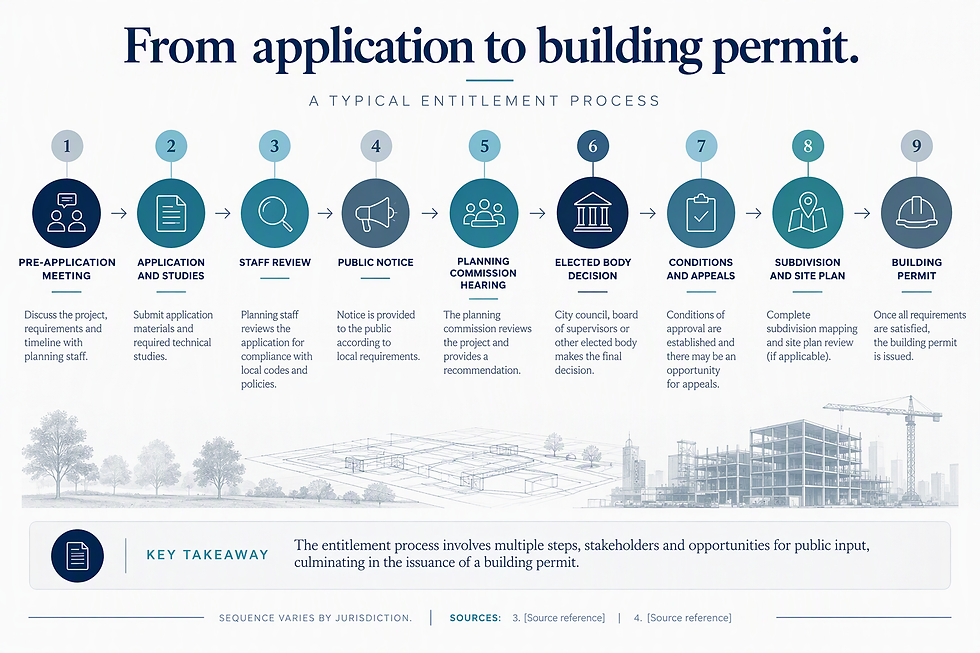
Figure 1: Process flow, “From application to building permit.”
Why Entitlements Matter for Value and Risk
Entitlements attach to the land and generally transfer when the property is sold, and entitled land is generally worth more than unentitled land because the buyer no longer carries the risk that approvals will be delayed or denied.² Academic evidence points the same way: a study of Chicago’s transit-oriented upzoning found property transaction values rose roughly 12% to 13% after the 2013 reform, and the increase appeared quickly, ahead of any development.⁵
Approvals also carry a direct cost. NAHB’s 2026 land developer survey puts the cost of applying for zoning approval at $7,007 per home in the single-family price, and estimates that regulation overall accounts for 26.4% of a new home’s price.¹ On the multifamily side, a 2022 survey by the National Multifamily Housing Council and NAHB found regulation accounts for an average of 40.6% of development costs. Among respondents, 74.5% had encountered neighborhood opposition, which added an average of 5.6% to costs and 7.4 months to timelines, and rezoning averaged 3.4% of development costs where it was required.⁶ The same survey attributed only 0.5% of costs to the pure cost of delay, so most of the burden came from the requirements themselves.⁶

Figure 2: Bar chart, “What makes up regulatory cost in multifamily development (share of total development cost).”
How States Are Rewriting the Process
Two recent examples show the direction of travel: moving projects from discretionary review to objective, by-right standards.
California. Assembly Bill 130 and Senate Bill 131 were signed on June 30, 2025, and took effect immediately. AB 130 created a new statutory exemption from the California Environmental Quality Act (CEQA) for qualifying infill housing on sites of up to 20 acres, and SB 131 constrains environmental review for projects that narrowly fail to qualify.⁷ Senate Bill 79, signed October 10, 2025 and effective July 1, 2026, overrides local density limits near major transit stops and makes qualifying transit-oriented projects eligible for streamlined, ministerial approval.⁸
Texas. Senate Bill 840, effective September 1, 2025, requires cities with more than 150,000 residents in counties above 300,000 to allow multifamily and mixed-use projects by right on land zoned for commercial, office, retail, warehouse, or mixed-use, without rezoning, variances, or other discretionary approvals. Cities must allow at least 36 units per acre and at least 45 feet of height, and the law excludes sites in heavy-industrial districts and near airports and military bases.⁹ The City of Irving, which is affected, notes that the law removes its ability to evaluate a site’s appropriateness for multifamily through the zoning process, and says that makes infrastructure planning harder.⁹

Figure 3: Two-column comparison, “Two states, two approaches.”
What Remains Unclear
The new laws are recent, and their effect on actual approvals and construction is not yet visible. Research on whether upzoning increases housing production is mixed, as one review of the literature concludes.¹⁰ The cost figures come from builder surveys by industry associations, and the 2022 multifamily result reflects only 49 developers, so they are estimates, not audits.¹ ⁶ Timelines vary widely by jurisdiction, and the definitions above come from practitioner sources, not a single legal standard.² ⁴ Local governments have raised concerns about infrastructure under by-right rules.⁹ Nothing here is legal advice; approvals depend on local law.
Questions to Ask Before Underwriting a Site
Is the project by right here, or does it need a discretionary approval?
Who decides, and at which stage: staff, a commission, or an elected body?
What studies are required, and how long do they take?
What do the carrying costs look like if approvals take six months longer than planned?
Do the entitlements transfer with the land, and what conditions come with them?
What is the appeal period, and who can use it?
What I find interesting is that the entitlement process is the part of a deal that doesn’t show up on a site visit. It is measured in months, hearings, and conditions, and it sets the clock for everything after it. As states shift more projects to by-right rules, the question for an investor changes from “Will the city say yes?” to “Does the project meet the standard?”
Sources
¹ National Association of Home Builders, Government Regulation in the Price of a New Home: 2026, June 8, 2026 (land developer survey).
² Shovels, “What Is Land Entitlement? The Real Estate Entitlement Process Explained,” 2026.
³ Clark Meyers, “The Zoning and Entitlement Process for Development,” 2026.
⁴ Barnes Walker, “Entitlement Process” and “Entitlement Process: Development” (legal glossary), 2026.
⁵ Yonah Freemark, “Upzoning Chicago: Impacts of a Zoning Reform on Property Values and Housing Construction,” Urban Affairs Review, 2020.
⁶ National Multifamily Housing Council and National Association of Home Builders, Cost of Regulations Report, 2022 (survey of 49 developers), with coverage by Multifamily Dive.
⁷ Holland & Knight, “California Legislature Enacts Major CEQA Reforms for Housing-Rich ‘Infill’ Projects,” July 2, 2025; Association of Bay Area Governments, summary of AB 130 and SB 131, April 2026.
⁸ Holland & Knight, “California’s 2026 Housing Laws: What You Need to Know,” December 2025; KQED, “California Passed Big Housing Laws in 2025. What Does That Mean for Building More Homes?”
⁹ City of Irving, “Multifamily By Right” (Texas SB 840); Haynes Boone, “Texas Senate Bill 840: By-Right Multifamily Development Now in Effect.”
¹⁰ Yonah Freemark, “Zoning Change: Upzonings, Downzonings, and Their Impacts on Residential Construction, Housing Costs, and Neighborhood Change,” Journal of Planning Literature, 2023.


Comments